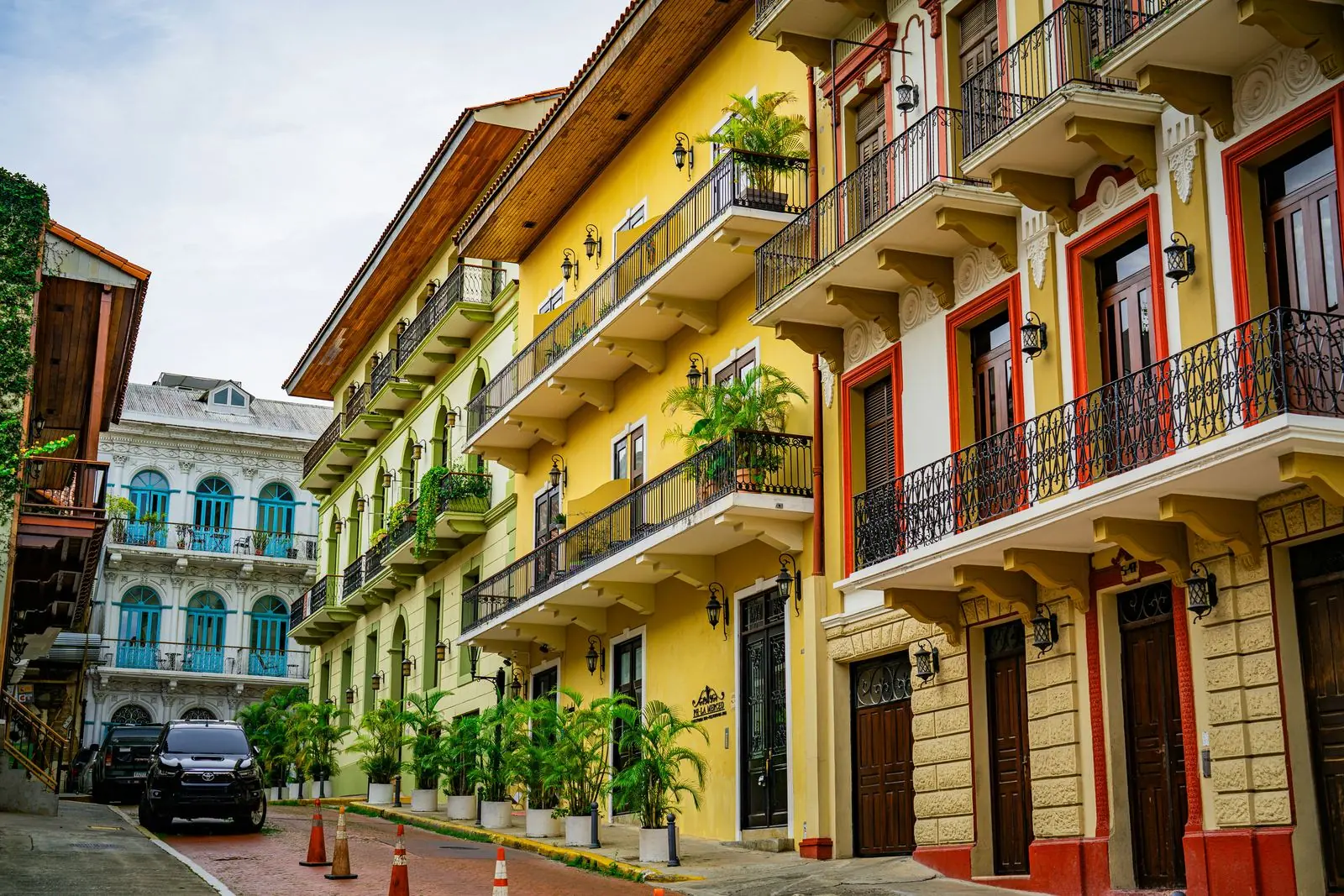
How Casco Viejo is laid out
Casco Viejo is built on a small peninsula that juts south into the Pacific. The neighbourhood has a simple rectangular grid — streets run roughly north–south (calles) and east–west (avenidas) — which makes navigation straightforward once you understand the basic orientation.
The peninsula is approximately 600 metres wide and 1 kilometre long. You can walk from the northern entrance on Avenida de los Mártires to the southern tip at Plaza de Francia in about 15 minutes at a leisurely pace. Most visitors get oriented within the first 20 minutes of walking.
The neighbourhood is officially called the Corregimiento de San Felipe — San Felipe is the barrio within Panama City's larger administrative structure. "Casco Viejo", "Casco Antiguo", and "El Casco" all refer to the same area.
Key streets to know
Avenidas (running east–west)
- Avenida de los Mártires: The broad avenue that forms the northern boundary of the neighbourhood — where most people enter from the modern city. Named for the 21 Panamanians killed during the 1964 flag riots.
- Avenida A: The first avenue inside the neighbourhood, running the length of the peninsula. More residential and less restored than Avenida B. Good for photography — raw, ungentrified street life.
- Avenida B: The neighbourhood's main artery. Most restaurants, bars, and boutique hotels are on or just off Avenida B. This is where to spend most of your time.
- Avenida Central: Runs along the southern edge near the sea wall and connects the neighbourhood's main plazas.
Calles (running north–south)
- Calle 1ra through Calle 12: The numbered calles run north to south. Calle 1 is at the southern tip (Plaza de Francia); Calle 12 is near the northern entrance. Most visitor activity is concentrated between Calles 3 and 9.
- Useful reference points: Plaza Mayor is at roughly Calle 7 and Avenida B. Plaza Bolívar is at Calle 4 and Avenida B. Plaza de Francia is at Calle 1, at the peninsula's southern tip.
📍 Tip: Panama uses both street names and "calles/avenidas" numbering. Locals more often use building names or landmarks rather than street addresses — "next to Tantalo" or "facing Plaza Bolívar" is more useful than a street number in conversation.
The three main plazas — your anchor points
The best way to orient yourself in Casco Viejo is by its three main plazas. They form a rough north-to-south spine through the centre of the neighbourhood:
The central plaza — cathedral, canal museum, archbishop's palace. The main orientation point. Most people start here.
The most charming plaza — shaded trees, cafés, colonial facades. About 3 blocks southeast of Plaza Mayor.
At the very tip of the peninsula, overlooking the bay. Best sunset views in the neighbourhood. French monument and sea wall.
A quieter plaza in the less-restored northern part of the neighbourhood. Less visited by tourists; good local atmosphere.
Key landmark locations
Main plaza, impossible to miss — twin towers visible from most of the neighbourhood.
The former Grand Hotel building on the north side of Plaza Mayor. Blue colonial facade.
One block west of Plaza Mayor. Simple exterior, extraordinary golden altar inside.
Three blocks south of Plaza Mayor. Look for the open-roofless ruins on Avenida A.
The most famous rooftop bar. On Avenida B, one block north of Plaza Mayor.
Run along the entire southern edge of the peninsula, connecting Plaza de Francia westward.
Restored vs unrestored zones
Casco Viejo is still mid-transformation. Roughly half the neighbourhood has been restored and is the polished, restaurant-and-hotel version you see in photos. The other half — primarily north of Plaza Mayor and along Avenida A — remains in various states of decay, still occupied by families who have lived there for decades.
The restored core runs between Calles 3–9 on Avenida B and southward to the sea wall. This is where most tourist activity happens and where it is entirely safe to walk at any time.
The unrestored northern area (Calles 9–12, and most of Avenida A above Calle 7) is less visited and requires more awareness, particularly after dark. In daylight it is interesting to walk through — the contrast with the restored zone is striking — but stick to the main streets and be sensible.
Get oriented with a walking tour
A two-hour guided tour is the fastest way to understand Casco Viejo's layout, history, and neighbourhoods. We cover the full peninsula — restored and unrestored — with the context that makes it all make sense.
Reserve Free Tour →