It starts with a palm: toquilla straw
Every genuine Panama hat begins as toquilla straw — the young shoots of Carludovica palmata, a palm-like plant that thrives in the humid lowlands of coastal Ecuador. Harvesters cut the unopened leaf shoots (cogollos) by hand, selecting only stalks at exactly the right stage: too young and the fibre is weak, too old and it coarsens.
That's the first surprise for most visitors: the classic "Panama hat" tradition is Ecuadorian — centred on the towns of Montecristi and Cuenca. Panama has its own distinct hat, the sombrero pintado, which we'll get to below. Both are woven wonders; they're just different crafts.
Preparing the straw
Before a single strand is woven, the raw shoots go through days of preparation:
- Splitting — the green outer skin is stripped and each shoot is split by hand (or with a needle comb) into ever-finer strands. For fine hats, a single shoot may yield strands thinner than sewing thread.
- Boiling — the strands are boiled to remove chlorophyll and sap, then hung to dry.
- Sulphur bleaching or sun-curing — traditionally the fibre is whitened over a sulphur fire or cured in sun and dew over several days until it reaches its ivory colour.
- Sorting — strands are graded for evenness; only flawless, uniform fibre goes into fine hats.
The weave: months of circular patience
Weaving starts at the centre of the crown — a small rosette called the plantilla — and grows outward in rings, the weaver adding strands as the circle widens, working the crown, then the sides, then the brim, in one continuous piece. There is no loom: it is entirely finger-woven.
Fine weavers in Montecristi work only in the early morning and evening, when humidity keeps the straw supple — direct daylight dries and snaps the finest strands. Some work bent over a wooden block in a posture unchanged for two centuries.
Key fact
A commercial-grade hat takes a few days to weave. A Montecristi superfino — with weaves so tight the surface feels like linen — can take a master weaver four to eight months of daily work.
Blocking, trimming and finishing
The woven body (campana) then passes to other specialists:
- Rematado — the loose ends at the brim edge are back-woven to lock the weave.
- Apaleado — the hat is pounded with a mallet to soften and even the weave.
- Blocking — steamed and pressed over wooden forms to take its final shape (fedora, optimo, planter…).
- Trimming and banding — the brim is cut and bound, and the classic black band added.
Grades: what makes a hat cost $30 or $3,000
Quality is measured by the weave count — how many rows of weave fit in an inch. A simple guide:
- Standard (under ~100 weaves/sq inch) — souvenir-grade, $20–60.
- Fino — visibly tight, even weave; $100–500.
- Superfino — 1,600+ weaves per square inch on the finest examples; the hat holds water and folds like cloth. These are collector pieces at $1,000 to well over $10,000.
Hold a hat up to the light: the more even and starless the pattern of light through the weave, the finer the hat.
Panama's own hat: the sombrero pintado
Panama's true national hat comes from La Pintada, in Coclé province, about two hours from Panama City. The process differs from the Ecuadorian craft:
- Fibres come from the bellota plant and junco reed, prepared and dried much like toquilla.
- Some fibres are dyed black by burying them in mud with dye plants (a technique similar to mud-dyeing textiles).
- The weaver braids flat bands called crinejas — alternating white and black in geometric patterns (talcos) — then sews the bands in a spiral from crown to brim.
- Quality is counted in vueltas — the number of rings of braid. A 12-vuelta hat is everyday wear; a 22-vuelta pintado is a work of art commanding hundreds of dollars.
In 2017 UNESCO added the pintado's artisanal process to its list of Intangible Cultural Heritage. You'll see pintados on folklore dancers and montuno wearers — the full story of that outfit is in our pollera and traditional dress guide.
Why is it called a Panama hat anyway?
Blame the canal. Ecuadorian hats shipped through Panama to gold-rush California and to the canal works, where they shaded thousands of labourers. When President Theodore Roosevelt was photographed wearing one at the canal excavation in 1906, newspapers called it a "Panama hat" — and the name stuck to the place of shipment, not the place of weaving. Full history in our Panama hat guide.
Judging quality when you buy
- Look through it at the light — even, tight, regular weave beats loose and starry.
- Check the centre rosette — a tight, symmetrical plantilla marks a careful weaver.
- Feel it — fine straw feels cool and cloth-like, never brittle.
- Ask what it is — an honest seller will tell you Ecuadorian toquilla from a Panamanian pintado; both are worth buying, for different reasons.
- Never roll a cheap hat — only fine, supple weaves tolerate gentle rolling, and even then briefly.
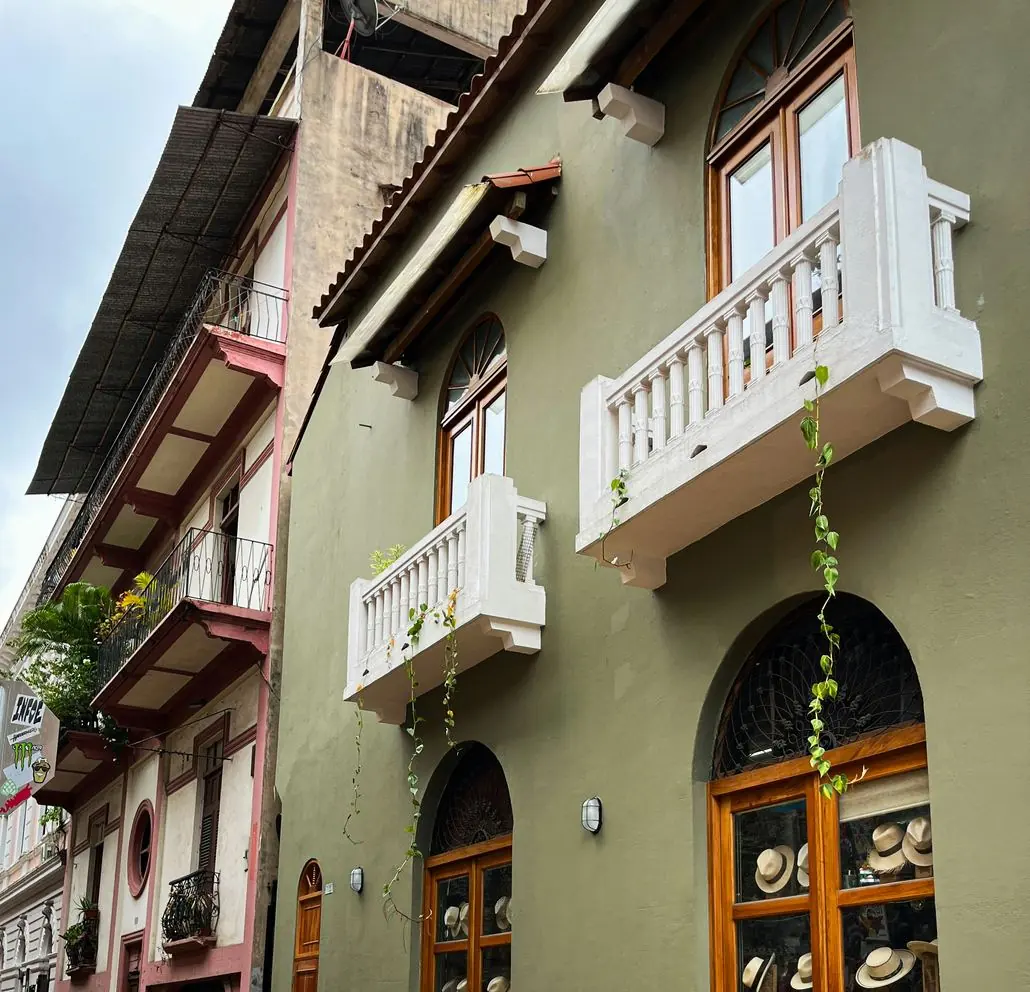
The hat street in Casco Viejo is the easiest place in the city to compare both traditions side by side — our hat street guide and shopping guide tell you where to start.
See the hats — and everything else — on foot
Our walking tours pass the hat street daily, and your guide can point you to the honest sellers. Start with the free colonial walk.
See Our Tours