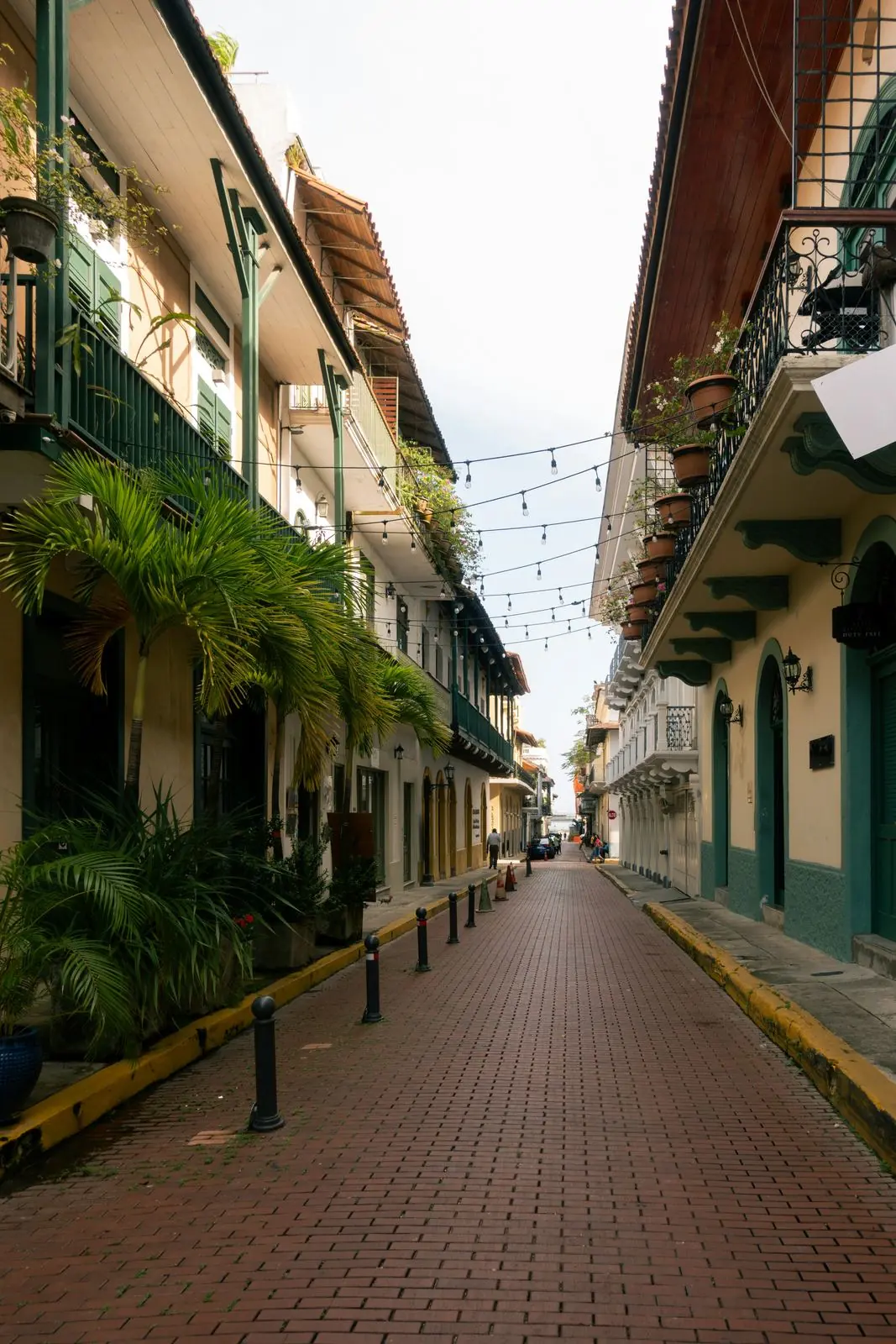
Overview of the neighbourhood
Casco Viejo occupies a small peninsula at the southern tip of Panama City, jutting into the Pacific Ocean. The neighbourhood covers roughly 0.7 km² — compact enough to walk end-to-end in 15 minutes, but rich enough to spend an entire day exploring. Most of its street grid follows a modified Spanish colonial layout, with the principal civic spaces arranged around Plaza de la Independencia (Plaza Mayor).
The neighbourhood's edges are defined by water on three sides and by the busy Avenida de los Poetas (Avenida A) to the north. Within those boundaries you'll find crumbling colonial ruins, restored boutique hotels, rooftop bars, working-class caserones, art galleries, and some of the best restaurants in Panama.
📍 GPS coordinates: 8.9507° N, 79.5350° W | Google Maps: search "Casco Viejo Panama" or "Casco Antiguo Panama City"
How to get to Casco Viejo
Getting to Casco Viejo is straightforward from anywhere in Panama City:
- Taxi / Uber: The most common option. From Miraflores Locks, about 15–20 min. From Tocumen International Airport, 30–45 min depending on traffic. Tell your driver "Casco Viejo" or "Casco Antiguo" — both are understood.
- Metro: Take Line 1 to 5 de Mayo station, then a short taxi or 20-minute walk south along Avenida Central.
- Bus: The Metrobús stops near the entrance on Avenida de los Poetas. Ask locally for the current routes as schedules change.
- Walking: If you're staying in Calidonia or nearby, Casco Viejo is walkable (20–30 min from the city centre).
Interactive map
Casco Viejo, Panama City
The suggested walking route
The route below covers Casco Viejo's 12 essential stops in a logical loop that avoids backtracking. Total walking distance is approximately 2.2 km. Allow 2–3 hours if you're stopping to look around, have a coffee, or sit in a plaza. Our free Colonial Walking Tour follows a version of this route with full historical commentary.
The route starts and ends at Plaza de la Independencia — the natural heart of the neighbourhood and the most identifiable meeting point. It runs anti-clockwise, keeping the waterfront views for the second half of the walk.
Key landmarks & stops
-
1
Plaza de la Independencia (Plaza Mayor)
The historic centre of the neighbourhood. Panama's declaration of independence from Colombia was signed here in 1903. The plaza is flanked by the Metropolitan Cathedral, the Cabildo (town hall), and the Grand Hotel Central. Most of our tours start here at 10am.
-
2
Panama Metropolitan Cathedral (Catedral Basílica Santa María la Antigua)
Completed in 1796 after over 100 years of construction. The twin white towers are the most photographed feature of Casco Viejo's skyline. Inside, look for the silver altar and the remains of a Panamanian bishop interred beneath the floor.
-
3
Church of San José and the Golden Altar
Home to one of the most remarkable objects in Panama — the intricately carved Altar de Oro (Golden Altar). According to legend, the altar was painted black to fool Henry Morgan's pirates in 1671 and preserve the original gold leaf. One block south of Plaza Mayor.
-
4
Plaza Bolívar
A leafy square dedicated to Simón Bolívar, who held the first Pan-American congress here in 1826. Surrounded by the Bolívar Palace (now a cultural centre) and shaded by large trees. A good spot for people-watching and an early morning coffee.
-
5
Church and Convent of San Francisco
One of Casco Viejo's most photogenic ruins — a roofless 17th-century convent with thick stone walls open to the sky. The ruins have been partially stabilised but remain unrestored, offering a striking contrast to the renovated buildings around them.
-
6
National Museum of Panamanian History
Housed in the former Grand Hotel, this small museum covers Panama's history from the colonial era through independence and the canal. Free on Sundays. A worthwhile 45-minute stop if you want historical context before exploring the streets.
-
7
Las Bóvedas (The Vaults)
A series of arched stone vaults along the waterfront seawall, originally used as military storage rooms and later as prisons. Now housing art galleries and restaurants. The promenade here — Paseo Las Bóvedas — offers panoramic views of the Pacific and the modern Panama City skyline.
-
8
Paseo Las Bóvedas & the Seawall
The long waterfront promenade is one of the most pleasant walks in all of Panama City. At the western tip of the peninsula you can see both the old neighbourhood behind you and the glittering skyline of Punta Pacífica ahead. This is the place for the classic Panama City sunset photograph.
-
9
French Plaque & Canal Administration Building
A reminder that Panama's relationship with the canal began with the French. The building and monument in this area commemorate the French canal effort of 1880–1904, which ended in disaster but laid the groundwork for the American project that followed.
-
10
Calle Primera (1st Street) — The Art & Restaurant Corridor
The main north-south street of the neighbourhood's most restored section. Lined with boutique hotels, restaurants, coffee shops, and art galleries. This is the stretch where Casco Viejo's gentrification is most visible — and most photogenic.
-
11
Tantalo Hotel Rooftop Bar
One of the original rooftop bars in Casco Viejo and still one of the best. Head up for a cocktail and unobstructed views of the bay, the Bridge of the Americas, and the Pacific. Open from mid-afternoon — best at sunset.
-
12
The Unrestored Streets (Avenida B & surrounds)
Venture one block off the main tourist circuit and you enter the neighbourhood's older, less-restored sections. Still inhabited, often strikingly beautiful in their decay, these streets give you the full picture of what Casco Viejo actually is — not just a postcard, but a living community still in the process of renewal.
Practical walking tips
- Best time to walk: Early morning (7–9am) for cool temperatures and empty streets, or late afternoon (4–6pm) for golden light and evening atmosphere. Midday heat (11am–2pm) can be intense, especially June–October.
- Footwear: Cobblestones are uneven. Wear comfortable closed shoes — not sandals, not heels. Genuinely.
- Sun protection: Panama is 9° from the equator. UV is intense year-round. Hat, sunscreen, and water are essential.
- Getting lost: Highly recommended. Casco Viejo is small enough that you can't get truly lost, and some of the best moments come from stumbling into an unmarked courtyard or a local bakery on a side street.
- Photography: The neighbourhood is exceptionally photogenic. The best light is morning or late afternoon. Ask permission before photographing residents.
- Safety: Casco Viejo is generally safe for tourists, especially in the restored areas. See our full safety guide here.
Want a guide to walk it with you?
Our free Colonial Walking Tour covers all the key landmarks with full historical commentary. Small groups, daily departures at 10am. No credit card required to reserve.
Reserve Your Free Spot →