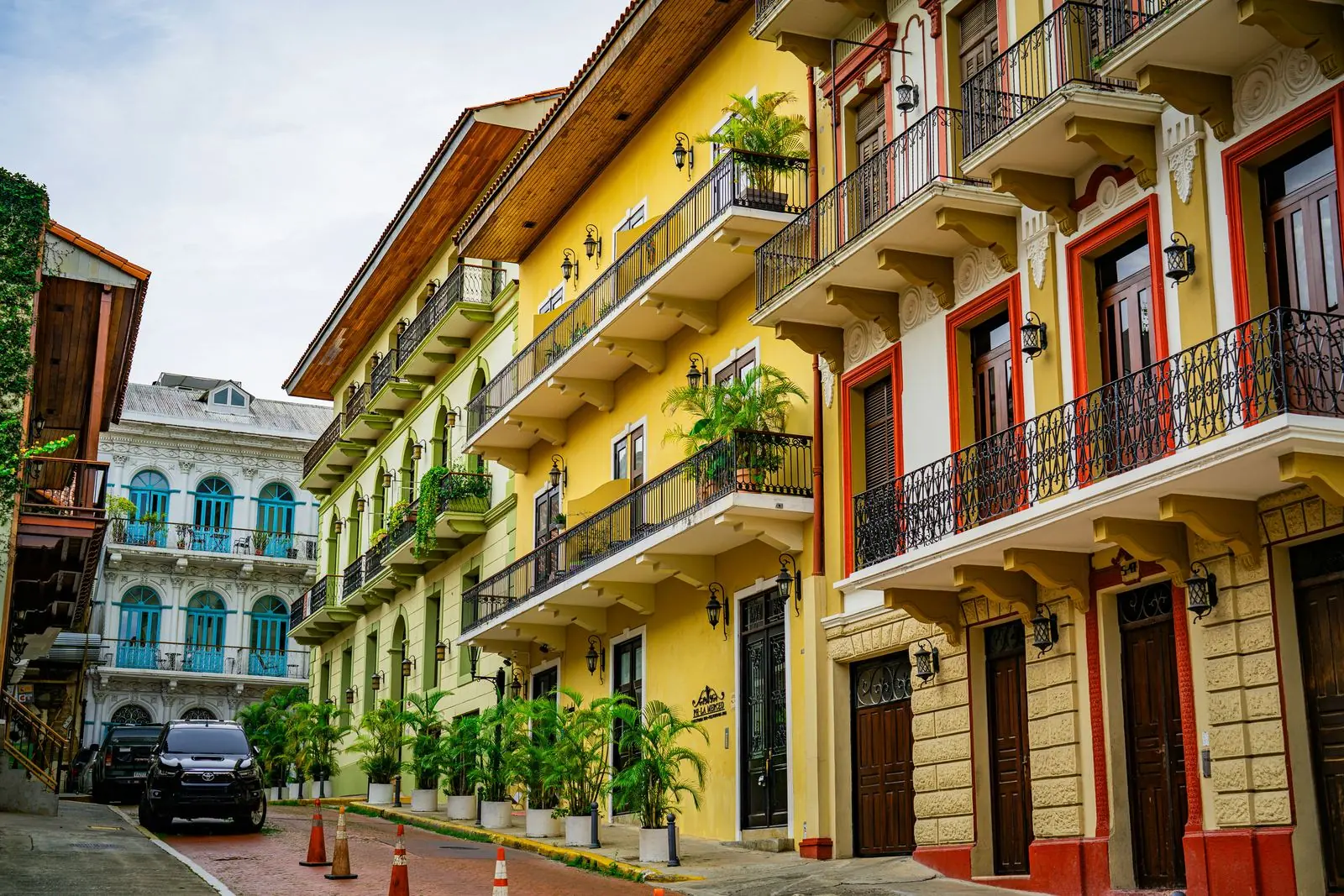
What is Casco Viejo?
Casco Viejo — literally "old helmet" or "old quarter" — is the historic colonial district of Panama City, founded in 1673 after the original Panama City (now known as Panama Viejo) was sacked and burned by the English privateer Henry Morgan. The neighbourhood sits on a small peninsula on the Pacific side of the isthmus, where the old city was rebuilt with a planned grid of streets and a sea wall to protect it against future raids.
Today it is a UNESCO World Heritage Site and one of the most remarkable historic districts in Latin America — not just for what has been preserved, but for the way old and new coexist. A crumbling colonial convent stands next to a boutique hotel that opened last year. A family who has lived in the same apartment for three generations shares a street with a Michelin-quality restaurant. It is a neighbourhood in the middle of a decades-long transformation, and that tension is part of what makes it so compelling.
📍 Also known as: Casco Antiguo, San Felipe, El Casco. All refer to the same historic peninsula district. "Casco Viejo" and "Casco Antiguo" are the most commonly used names — they mean the same thing.
A brief history of Casco Viejo
Panama City was the first European city on the Pacific coast of the Americas, founded by the Spanish in 1519. For 150 years it was the most important city in the Spanish empire's Pacific trade network — the point through which gold and silver from Peru passed on its way to Spain via the mule road across the isthmus.
In 1671, Henry Morgan led an army of 1,200 buccaneers across the isthmus and attacked Panama City from the land side — a direction the city's defenders had not expected. After a fierce battle, the city burned to the ground. Whether the fire was set by the Spanish to deny Morgan the treasure, or by Morgan's men, is still debated by historians. The ruins remain visible today at the Panama Viejo archaeological site, 8km east of Casco Viejo.
The new city — today's Casco Viejo — was founded two years later on the peninsula, with a sea wall on three sides and a planned street grid. It was the capital of Panama until 1903, when Panama gained independence from Colombia. As the city modernised and expanded eastward through the 20th century, Casco Viejo fell into disrepair. By the 1990s it was one of the most impoverished and dilapidated historic districts in Central America.
The UNESCO listing in 1997 began a slow reversal. Investment arrived. Hotels, restaurants, and galleries moved in. The restoration continues today — roughly half the neighbourhood has been restored, and half remains in various states of ruin and occupation.
Best things to see in Casco Viejo
The central plaza of the old city, where Panamanian independence was declared in 1903. Surrounded by the National Cathedral, the Archbishop's Palace, and the Grand Hotel (now a cultural centre). The best place to orient yourself at the start of any visit.
Construction began in 1688 and took over a century to complete. The twin towers are inlaid with mother-of-pearl from the Pearl Islands. This is the most photographed building in Casco Viejo and worth stepping inside — the interior is vast, cool, and largely original.
One of the most atmospheric ruins in Panama — an open-air roofless convent church with a famous 17th-century brick arch that has stood for over 300 years without mortar. The arch was cited as proof that Panama's seismic stability made it suitable for the canal construction. The Museo de Arte Religioso Colonial is housed in an adjacent building.
The neighbourhood's most charming plaza, shaded by tropical trees and surrounded by colonial buildings housing restaurants and cafés. Named for Simón Bolívar, who convened the Amphictyonic Congress here in 1826 — the first attempt to unite Latin American nations. At its centre stands an 1883 monument to Bolívar.
At the southern tip of the peninsula, this plaza honours the French workers who died during the failed French attempt to build the canal (1881–1889). A row of plaques lines the sea wall, and an obelisk topped with a Gallic rooster marks the spot. The views over the bay from here at sunset are exceptional.
The best museum in Panama City and one of the finest in Central America. Housed in the former Grand Hotel, it traces the complete history of the Panama Canal from pre-Columbian trade routes to the 2016 expansion. Allow at least two hours.
When to visit Casco Viejo
Dry season (January–April) is the most popular time. Low humidity, reliable sunshine, and the best conditions for walking. January and February are the most comfortable months.
Rainy season (May–December) brings daily afternoon showers — typically heavy but brief. Mornings are usually clear. The neighbourhood is quieter and prices are lower. The rain also makes the colonial facades and tropical vegetation more vivid.
For the best time of day, visit in the early morning (before 9am) for empty streets and good light, or in the late afternoon (4–7pm) for the golden hour and rooftop bar access.
Practical visitor tips
- Getting there: Uber from the financial district takes 15–20 minutes and costs $4–8. There is no metro stop in the neighbourhood — the closest is Cinco de Mayo station, a 20-minute walk.
- Getting around: The neighbourhood is entirely walkable. The peninsula is roughly 600m wide and 1km long — you can cross it in 10 minutes.
- Safety: The restored core of Casco Viejo is safe during the day and in the evenings. Stick to the central streets and squares. The unrestored northern edges of the neighbourhood require more caution.
- What to wear: Comfortable walking shoes — the cobblestones are uneven. Light clothing for the heat. A layer for air-conditioned restaurants and museums.
- Money: Panama uses the US dollar. ATMs are available near Plaza de la Independencia. Most restaurants and bars accept cards, but carry small bills for street food and tips.
Explore Casco Viejo with a local guide
Our free colonial walking tour covers 350 years of history in two hours — the stories behind the ruins, the plazas, the colonial churches, and the neighbourhood's remarkable resurrection.
Reserve Free Tour →