The original city — Panama Viejo (1519)
Panama City is one of the oldest continuously inhabited European settlements in the Americas. Panama Viejo — the original city — was founded on August 15, 1519, by the Spanish conquistador Pedro Arias Dávila (known as Pedrarias). It became the first permanent European settlement on the Pacific coast of the Americas.
The strategic importance of Panama was immediately clear: it was the narrowest point of the isthmus, making it the most efficient crossing point for Spanish treasure moving from South America to Spain. Gold and silver from the Inca Empire passed through Panama City in enormous quantities. At its height, Panama Viejo was one of the wealthiest and most important cities in the Spanish colonial world.
Key fact
Panama Viejo's ruins still stand 8km east of Casco Viejo and are themselves a UNESCO World Heritage Site. The stone tower of the original cathedral is visible from the modern highway. Combined with Casco Viejo, the two sites form a single joint UNESCO designation that is unique in the Americas.
Henry Morgan and the pirate raid
On January 28, 1671, the Welsh privateer Henry Morgan arrived at Panama City with approximately 1,400 men after a gruelling 9-day march across the isthmus from the Caribbean coast. The Spanish governor had been warned of the attack and attempted a defence, but Morgan's forces overwhelmed the city's defenders.
What followed was the most destructive pirate raid in the history of the Americas. The city burned for nearly a month. Whether Morgan himself set the fires, or whether the Spanish burned their own city to deny the pirates access to its treasures, has been debated by historians for centuries. What is not disputed is the result: Panama Viejo was utterly destroyed.
Morgan's raid was the end of Panama Viejo. The city that had stood for 152 years was reduced to ruins. The Spanish decided not to rebuild on the same site — the existing location was indefensible. They would build a new city, two miles to the southwest, on a rocky peninsula that could be fortified and defended from the sea.
Historical note
Morgan was technically a privateer, not a pirate — he operated under a commission from the British Crown authorising raids on Spanish colonies. After the raid, he was arrested and brought to England, but was ultimately knighted by King Charles II and appointed Lieutenant Governor of Jamaica. Whether hero or villain depends entirely on your perspective.
The founding of Casco Viejo
In January 1673, two years after the destruction of Panama Viejo, the new city was formally established on a rocky peninsula to the southwest. The Spanish chose this location specifically for its defensibility — it was naturally protected on three sides by the sea, and the narrow land approach could be fortified with walls and a moat.
The new city was designed in the classic Spanish colonial grid pattern: a central plaza (Plaza Mayor, now Plaza de la Independencia), a cathedral, government buildings, convents, and merchant houses arranged in regular blocks. Many residents and institutions moved their operations from the ruins of Panama Viejo to the new site, carrying salvaged materials — stone, wood, and tiles — with them.
The city was known simply as La Ciudad de Panamá (Panama City) until the 20th century, when the old quarter was distinguished from the expanding modern city by the name Casco Viejo (old hull or old quarter) or Casco Antiguo (old quarter — both names are used and mean the same thing).
Spanish colonial era
For nearly 150 years after its founding, Casco Viejo functioned as the capital of Spanish colonial Panama — an immensely important transit hub where Pacific trade goods arrived from South America, crossed the isthmus, and departed for Spain via the Caribbean. The wealth of the Spanish Empire passed through this peninsula.
The architecture that still defines Casco Viejo today was built during this period. The Cathedral of Panama (facing Plaza de la Independencia) was built over a span of more than 100 years, from 1688 to 1796. The Church of San José, home to the famous golden baroque altar, was established in this era. The Convento de Santo Domingo — whose ruins are now one of the neighbourhood's most photographed landmarks — was built in 1678.
The Paseo Las Bóvedas seawall and its stone vaults (bóvedas) were built in the 18th century as a combination of coastal defence wall and storage facility. The vaults stored gunpowder and colonial goods. Today they house art galleries and restaurants, but the structure itself — more than 300 years old — is intact.
Independence and the French canal era
On November 28, 1821, Panama declared independence from Spain — peacefully, almost without incident, in a ceremony at Plaza de la Independencia. The plaza is still the heart of Casco Viejo today; the act of independence that took place there remains one of the most significant moments in Panamanian national identity.
Panama joined Gran Colombia (Colombia) rather than becoming a fully independent nation. That arrangement would last until 1903.
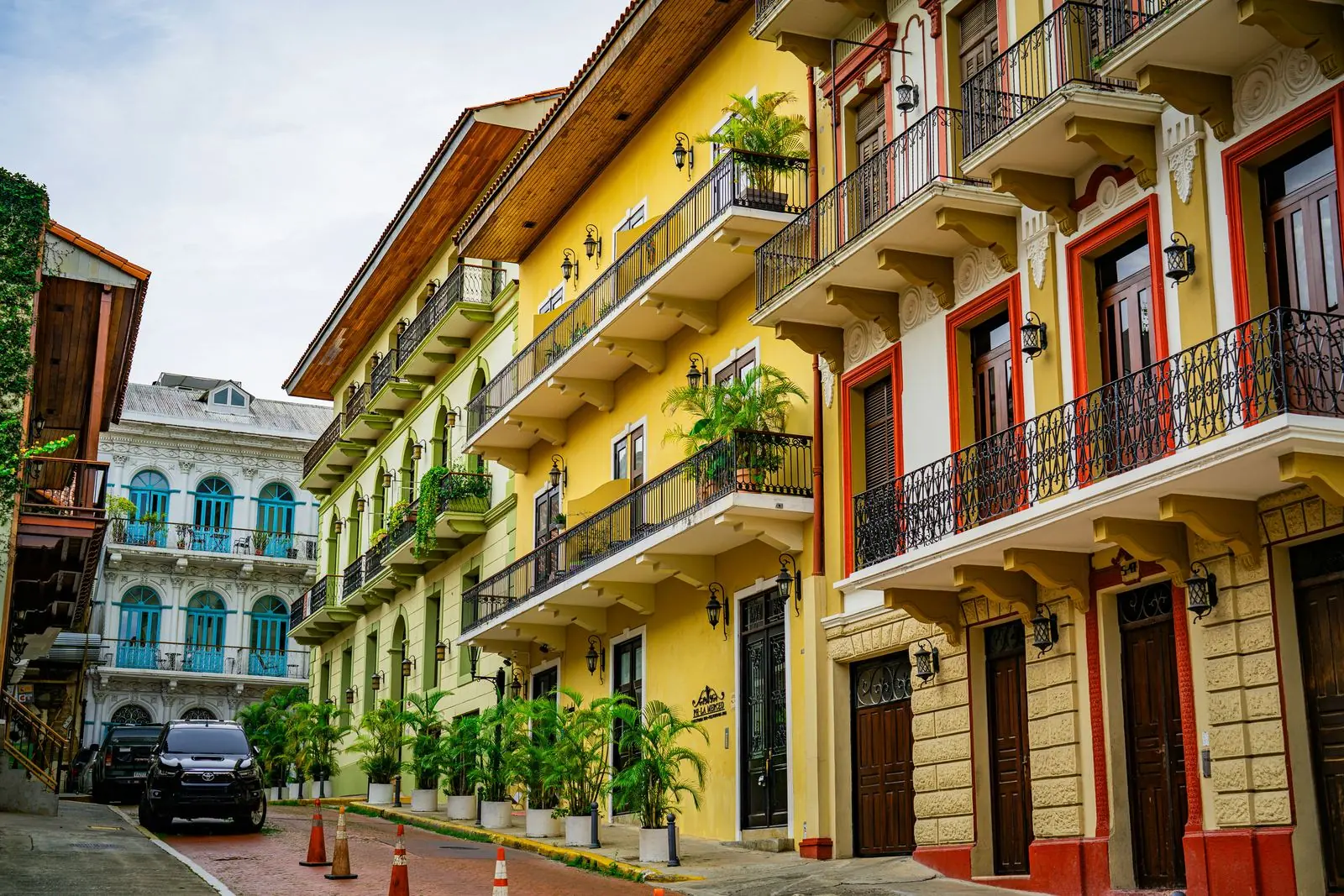
The mid-19th and early 20th centuries brought a wave of French architecture to Casco Viejo. France's attempt to build a Panama Canal — the first, disastrous attempt, begun in 1881 under Ferdinand de Lesseps — brought thousands of French engineers, administrators, and workers to Panama City. They left behind a distinctive French architectural character: ironwork balconies, mansard roofs, and art nouveau details that still appear on buildings throughout Casco Viejo alongside the older Spanish colonial structures.
In 1826, Simón Bolívar convened the Congress of Panama in Plaza Bolívar — an attempt to create a unified federation of Latin American nations. The congress failed politically, but the plaza still bears Bolívar's name and a statue in his honour.
Decline and abandonment
Panama declared independence from Colombia on November 3, 1903, with significant US backing — the Americans needed a friendly Panamanian government to sign the Canal Treaty. The US then built the Panama Canal between 1904 and 1914, fundamentally transforming the country and shifting its economic centre of gravity.
As Panama City grew rapidly through the 20th century, the colonial old quarter began to lose its prestige. Wealthy families and businesses moved to newer, modern neighbourhoods. Casco Viejo's mansions were subdivided into tenements. Buildings were neglected, and many fell into serious disrepair. By the 1970s and 1980s, significant portions of the neighbourhood were classified as slums. Some of the finest colonial buildings in the Americas sat crumbling, occupied by families who could not afford repairs.
UNESCO designation and the revival
In 1997, Casco Viejo was declared a UNESCO World Heritage Site — jointly with the Panama Viejo ruins — as "Archaeological Site of Panama Viejo and Historic District of Panama." The designation recognised the site's outstanding universal value as one of the finest examples of Spanish colonial urban planning in the Americas, and as a site of exceptional historical significance to the story of European expansion and the Panama Canal.
The UNESCO designation triggered a wave of restoration investment. Over the following two decades, many of Casco Viejo's most beautiful colonial buildings were carefully restored — hotels, restaurants, art galleries, and residences occupying buildings that had been derelict for decades. The neighbourhood became one of the most dramatic gentrification stories in Latin America.
Today, Casco Viejo is simultaneously a living working-class neighbourhood (many original residents remain), a major tourist destination, and one of the most architecturally extraordinary places in the Western Hemisphere. The tension between these realities — historic preservation, gentrification, and authentic community life — is part of what makes it one of the most interesting places in the Americas to spend time.
Experience the history in person
Our free colonial walking tour brings this 350-year story to life across the neighbourhood's most significant sites. Daily at 10am, led by guide Carlos Mendoza — who has been telling this story for 12 years.
Reserve Free Spot →