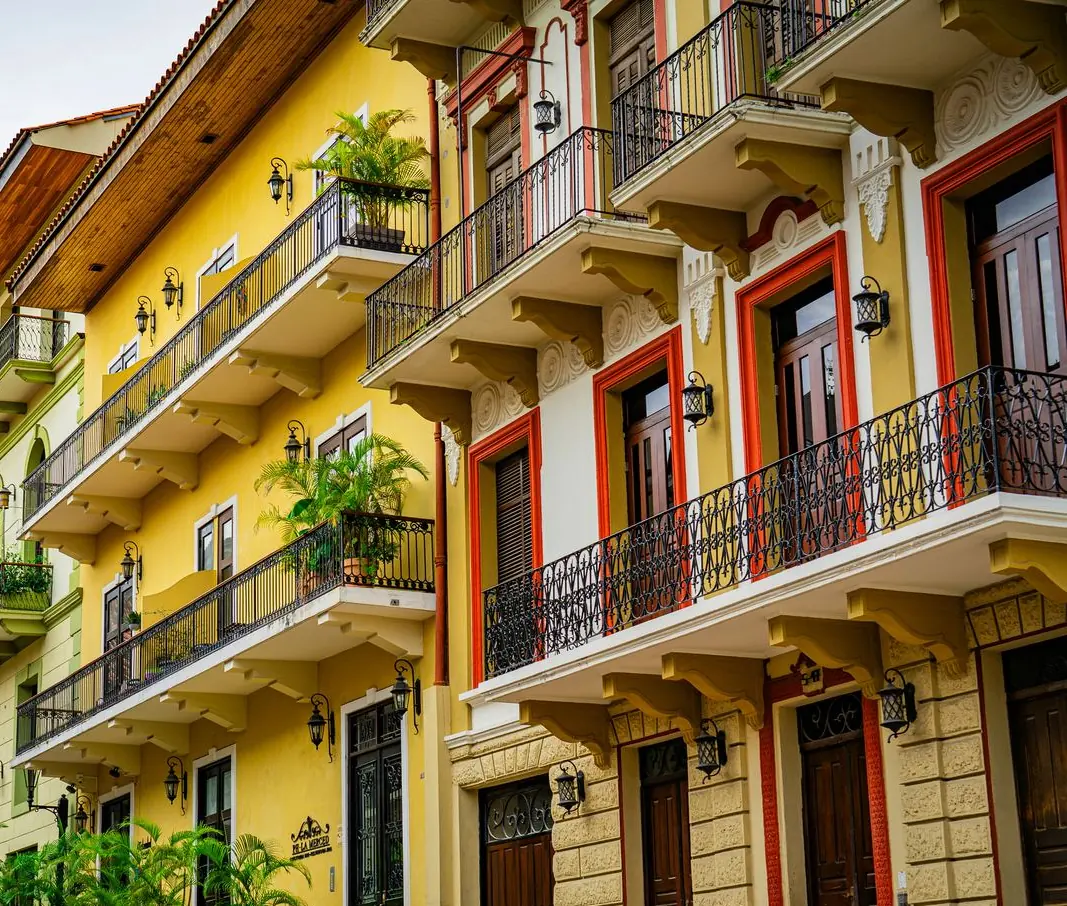
Casco Viejo's tourist trail is well-worn: Plaza Bolívar, the Golden Altar, Plaza de Francia, a rooftop drink, back to the hotel. It is a good trail. But the neighbourhood holds a second layer — courtyards behind closed doors, streets the tour groups never reach, viewpoints with better angles than the famous ones, buildings with stranger histories than anything on the official walking route. This is a guide to that layer.
Hidden courtyards
Courtyard
The Ruinas de Santo Domingo interior
The famous arch of Santo Domingo — the flat arch that stood for centuries without a keystone and allegedly convinced engineers that Panama was an earthquake-free zone — is on every tourist map. What most visitors miss is the interior of the ruined convent behind it: a roofless space of extraordinary proportions, with original colonial stonework walls rising to the open sky and a floor of cracked paving that has been gradually reclaimed by weeds and ferns. There is no sign directing you inside. Push the gate open and walk in.
Courtyard
The patio of Casa del Obispo
The bishop's house — one of Casco Viejo's finest colonial mansions — has a ground-floor café that opens onto a shaded interior courtyard invisible from the street. The café is worth stopping at regardless; the courtyard, with its original stone floor, potted heliconias, and the sound of the street entirely absent, is one of the quietest spots in the neighbourhood. Mid-afternoon, when the tour groups have left, you may have it to yourself.
Courtyard
The French Legation courtyard
An 18th-century colonial building that once housed the French diplomatic mission during the canal era. The street facade is unremarkable — typical ochre plaster, wooden balconies. The interior courtyard (accessible through the ground-floor gallery that sometimes operates here) is two storeys of original ironwork balconies surrounding a central garden. One of the most beautiful architectural interiors in the neighbourhood. Check if the gallery is open before visiting; hours vary.
The streets most visitors skip
Street
Calle 4a Este — the forgotten street
While most walking routes follow Avenida Central and Avenida B, Calle 4a Este runs perpendicular to both and passes through a section of the neighbourhood that is still in mid-gentrification — beautiful colonial ruins next to carefully restored mansions, a small church that has been quietly serving the same community for three centuries, and the kind of unmediated street life that disappears quickly as neighbourhoods become tourist destinations. Walk it slowly in the morning.
Street
The passage behind Las Bóvedas
Las Bóvedas — the sea wall dungeons at Plaza de Francia — is on every itinerary. Almost nobody walks the narrow passage that runs along the outside of the sea wall, between the old stone and the actual waterfront. From here you see the bay without the plaza's crowd, with the full weight of the 17th-century fortification wall rising to your left and the Pacific stretching to your right. At high tide, water occasionally washes over the lower sections of the passage. Worth timing.
Secret viewpoints
Viewpoint
The rooftop of the Interoceanic Canal Museum
The museum on Plaza de la Independencia has a rooftop terrace that most visitors never reach because it requires going back to the front desk after your museum visit and asking specifically. The view from here — directly over the plaza's palms to the bay, with the financial district skyline visible to the east — is one of the best in Casco Viejo and involves none of the waiting or drink minimums of the rooftop bars. Free with museum admission ($2).
Viewpoint
The north sea wall at Calle 1a
At the northern end of the peninsula, where Calle 1a meets the water, there is a stretch of sea wall facing the bay of Panama City proper — the opposite direction from the famous south-facing views at Plaza de Francia. From here you see the container port at Balboa, ships at anchor in both directions, and the Bridge of the Americas in the distance. No benches, no café, no tourists. Just the view and the wind off the water.
Wall murals worth finding
Casco Viejo has developed a significant street art scene over the past decade, concentrated in the transitional areas between the renovated historic core and the working-class streets to the north. The murals here are not tourist-facing decoration — they are political, personal, technically accomplished, and change regularly as buildings are renovated or artists return. A few that tend to persist:
- The Guna cosmology mural near Avenida Central — a large-scale work depicting Guna spiritual figures in traditional mola colours. Artist: a collaborative project with Guna community members.
- The portero building on Calle 7a — an entire facade painted in geometric patterns derived from Colombian Pacific coast textile traditions. Extraordinary at golden hour when the light hits the west-facing wall.
- The French canal workers memorial mural near the French Embassy — a figurative work depicting the largely forgotten West Indian and French workers who died during the failed first canal attempt in the 1880s. Historically significant and technically strong.
For a more comprehensive mural tour, see our Casco Viejo street art guide.
Overlooked buildings with stranger histories
Building
The Hotel Central — Panama's first modern hotel
On Plaza de la Independencia, the Hotel Central was Panama's premier hotel at the time of independence in 1903 and hosted the dignitaries who negotiated the canal treaty. It later declined into a rooming house, then a ruin. The currently half-restored facade hides a building that has watched more Panamanian history pass through it than almost any other structure in the neighbourhood. The ground floor is sometimes accessible; ask at the adjacent businesses.
Building
The old fire station on Avenida Central
A beautiful Italianate building with a tower that was built in the early 20th century to house the Casco Viejo fire brigade. The fire brigade was originally staffed by volunteers — Chinese Panamanian immigrants played a significant role in its founding, a detail that connects to the Chinese community's complex history in the canal era. The building is not officially open to visitors but the exterior facade, with its original tower, is worth stopping to look at.
The most reliable local tip
Walk before 8am. Casco Viejo before the tourist day begins — before the tour groups arrive, before the cafés fully open, before the heat — is an entirely different city. The light is extraordinary. The streets are quiet except for residents going to work. The sounds are ordinary domestic sounds: coffee being made, a radio playing, a dog sleeping on a doorstep. If you stay in the neighbourhood, set your alarm and walk for an hour before breakfast. You will see something the midday tourist never gets to see.
Find the hidden layer of Casco Viejo with a local guide
Our walking tours take you off the standard tourist route — into the courtyards, down the forgotten streets, past the buildings most visitors walk straight past. Small groups, local knowledge, two hours.
Book the Walking Tour →